Augustinergasse and the left-bank lanes
Augustinergasse is a 200 m lane on the left bank of Zurich Old Town, from Bahnhofstrasse past the Augustinerkirche to St. Peterhofstatt, lined with brightly painted oriel windows. Around it lie Rennweg, the Schipfe on the river, Weinplatz with the Roman baths under Thermengasse, and the Münsterhof, the largest square of the Old Town.
Updated
Key facts
- Augustinergasse
- 200 mBahnhofstrasse to St. Peterhofstatt, 3 min on foot
- Rennweg
- 210 mBahnhofstrasse to Strehlgasse
- Schipfe
- 340 mAlong the Limmat, below the Lindenhof
- Roman baths
- FreeAny time, through a grid in Thermengasse
- Münsterhof
- Largest squareOf the Old Town; redesigned in 2016
- Nearest stop
- RennwegTrams 7, 11, and 13
- Weinplatz
- 1 min on footFrom the Rathausbrücke
Where the left-bank lanes are
The lanes lie on the left bank of the Limmat, between Bahnhofstrasse and the river. The left bank's pedestrian zone runs along the river from the Rudolf-Brun-Brücke over the Lindenhof and the Münsterhof to the Rathausbrücke.
Trams 7, 11, and 13 to Rennweg
The stop is on Bahnhofstrasse, where Rennweg begins.
Trams 2, 5, 7, 9, 11, and 13 to Paradeplatz
From Paradeplatz the Fraumünster and the Münsterhof are 3 min on foot away.
Trams 4 and 15 to Rathaus
The stop is on the Limmatquai at the Rathausbrücke. Weinplatz is across the bridge, 1 min on foot from its middle.
- AugustinergasseWhere the lane leaves Bahnhofstrasse.
- Museum StrauhofAugustinergasse 9: literature exhibitions.
- MünzplatzThe Augustinerbrunnen and the Augustinerkirche.
- St. PeterhofstattThe square below St. Peter, where Augustinergasse ends.
- RennwegThe Amazonenbrunnen, at the corner of Strehlgasse.
- SchipfeIts north end, near the Rudolf-Brun-Brücke.
- WeinplatzThe Winzerbrunnen, at the end of the Rathausbrücke.
- Roman bathsUnder a grid in Thermengasse.
- MünsterhofThe square in front of the Fraumünster.
Augustinergasse and its painted oriels
Augustinergasse runs 200 m from Bahnhofstrasse past the Augustinerkirche to St. Peterhofstatt, the square in front of St. Peter, 3 min on foot from end to end. Many of its houses have well-preserved oriel windows, painted in bright colors.
The Strohhof on the lane was a manufactory, founded in the 16th or 17th century and still working in the 19th. At Augustinergasse 9, the Museum Strauhof puts on exhibitions about literature.
The Augustinerkirche on Münzplatz, a plain hall church built from 1270, was a monastery church. Since 1873 it has been the church of the Christ Catholic parish, open every day.
Münzplatz and the Augustinerbrunnen
Münzplatz is a triangular square beside the Augustinerkirche. It takes its name from the city mint, which was set up in the church's choir; the Haus zur Münz of the 1930s stands where the choir stood.
The fountain on the square is the Augustinerbrunnen. In 1577 it was called the "Augustinersod", which points to a shaft well. Its wooden basin was replaced in stone in 1586, and shortly after, the sculptor Johannes Tub made its Renaissance column. The figure on top, a statue of Temperance, replaced an earlier one when the fountain was renovated in 1761.
Rennweg and Strehlgasse
Rennweg runs 210 m from Bahnhofstrasse to Strehlgasse and In Gassen. It was laid out around 1300 on the ditch of an earlier town fortification, as the main lane of the left bank and the road out towards Baden. After the town wall and its gate were razed in 1865, the wide, straight street with its shops became an important link between the Old Town and the new business district.
At the corner of Strehlgasse stands the Amazonenbrunnen, on record since 1430. Strehlgasse carries Rennweg on as a fairly steep medieval lane. It branches several times and is lined with stepped houses, most of them with shops. The Widder Bar is in the Widder Hotel on Rennweg.
The Schipfe on the river
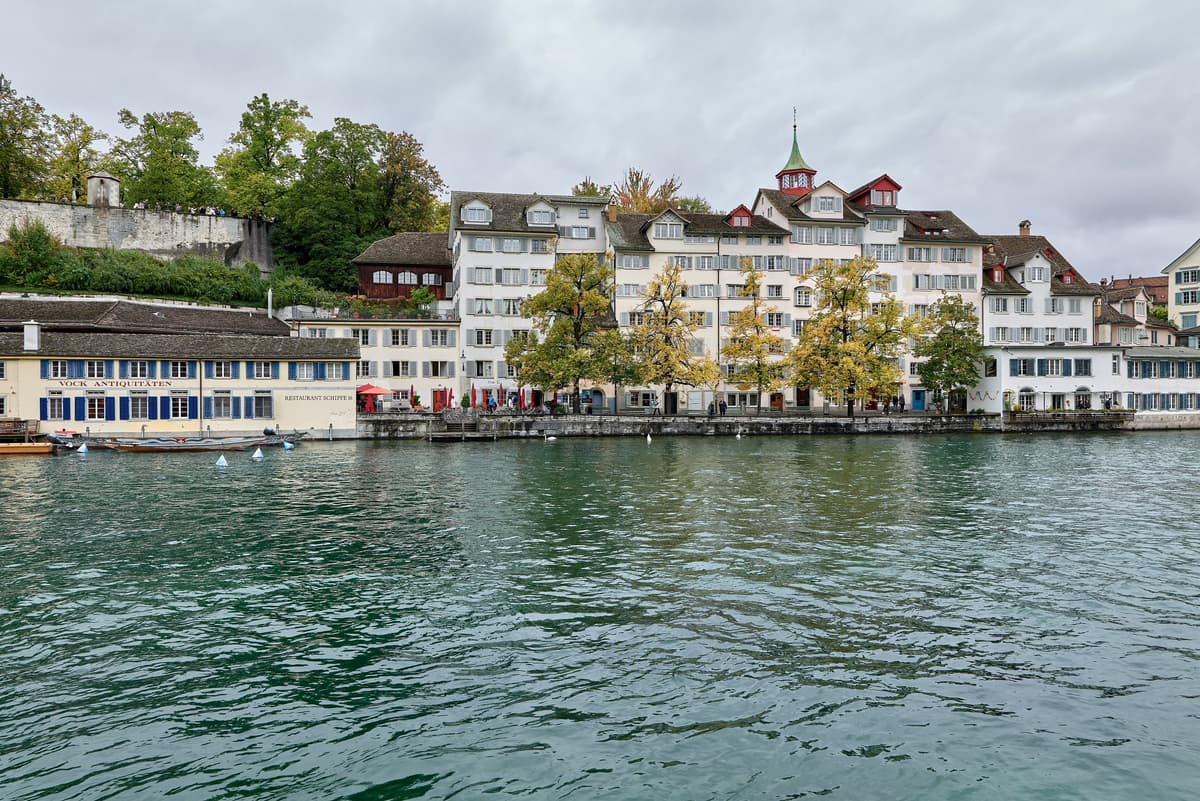
The Schipfe runs 340 m along the Limmat, from Uraniastrasse near the Rudolf-Brun-Brücke to Weinplatz. Its name comes from the boatmen who pushed ("schupfen") their boats onto the bank and back into the water. In the Middle Ages it was a landing place for important goods. From the 16th century it had silk works, bathhouses and boatbuilders, and the Wollenhof here was a manufactory that kept working into the 19th century.
The Schipfe is still a lane of craftspeople, with small shops and workshops by the river. Above it rises the Lindenhof, a terrace with lime trees on a moraine hill and the highest point of the left-bank Old Town.
Weinplatz and the Winzerbrunnen
Weinplatz is a small rectangular square at the end of the Rathausbrücke, which is also called the Gemüsebrücke. It was laid out as a market square after the Kornhaus was pulled down in 1620, and the Zunfthaus zum Weggen and old inns stand around it.
The Winzerbrunnen of 1908 has a small bronze winegrower under a canopy. It recalls the trade in local wine held on the square from 1630 to 1674.
The Rathausbrücke is being rebuilt until 2029. Pedestrians keep a passage on its north side, and a temporary bridge on the south side joins Weinplatz to the Limmatquai.
The Roman baths under Thermengasse
In the narrow Thermengasse off Weinplatz, a grid in the ground shows the remains of Zurich's Roman baths: part of the heating system and the walls of a small first bath and a much larger, somewhat later one. Excavations show that the Roman settlement reached from the military camp to the harbor and the baths at today's Weinplatz.
The remains were found during building work and have been on view since the excavations of 1983 and 1984; new panels were added in 2009. They can be seen at any time and free of charge through the grid, with a display case and texts beside it. Thermengasse is 2 min on foot from the Rathausbrücke.
Münsterhof, the largest square of the Old Town
Between the Fraumünster and the Zunfthaus zur Meisen lies the Münsterhof, the largest square of the Old Town. It was laid out from 1250 on the abbey's former cemetery and is enclosed by the church, medieval houses with shops and two guild houses. It was redesigned in 2016, and it lies in the pedestrian zone.
In Advent the square holds the Weihnachtsmarkt Münsterhof, one of the city's Christmas markets.
St. Peterhofstatt
Augustinergasse ends at St. Peterhofstatt, a large rectangular square with a mighty lime tree in the middle and houses on three sides. A wide flight of steps leads up to the forecourt of St. Peter.
Frequently asked questions
How long is Augustinergasse?
Augustinergasse is 200 m long, from Bahnhofstrasse past the Augustinerkirche to St. Peterhofstatt: 3 min on foot.
Can you see the Roman baths in Zurich?
Yes. In Thermengasse, by Weinplatz, the remains of two Roman baths can be seen through a grid in the ground at any time, free of charge: part of the heating system and the walls. They have been on view since the excavations of 1983 and 1984.
What is the largest square in Zurich Old Town?
The Münsterhof, between the Fraumünster and the Zunfthaus zur Meisen. It was laid out from 1250 on the abbey's former cemetery and redesigned in 2016.
Why is it called the Schipfe?
The name comes from the boatmen who pushed ("schupfen") their boats onto the bank and back into the water. In the Middle Ages the Schipfe was a landing place for goods on the Limmat.
What is the fountain on Münzplatz?
It is the Augustinerbrunnen. It was first named, as the "Augustinersod", in 1577; its stone basin dates from 1586, and its figure, a statue of Temperance, from the renovation of 1761.