Lindenhof
The Lindenhof is a public square on a hill on the left bank of Zurich Old Town, more than 20 m above the Limmat. Under its lime trees, the terrace looks across the river to the Grossmünster, the Rathaus and the university buildings. It stands on the walls of a Roman fort, 4 min on foot from the Rathausbrücke.
Updated
Key facts
- What it is
- A public squareOn a hill on the left bank, under lime trees
- Height
- Over 20 mAbove the left bank of the Limmat
- From the Rathausbrücke
- 4 min on foot260 m, up Pfalzgasse
- From Zürich HB
- 9 min on foot620 m, up Lindenhofstrasse
- Nearest tram stop
- RennwegTrams 7, 11, and 13
- Without steps
- PfalzgasseSteps on Fortunagasse and Lindenhofstrasse
- On the square
- Accessible toiletChess, pétanque and a playground
The view across the Limmat
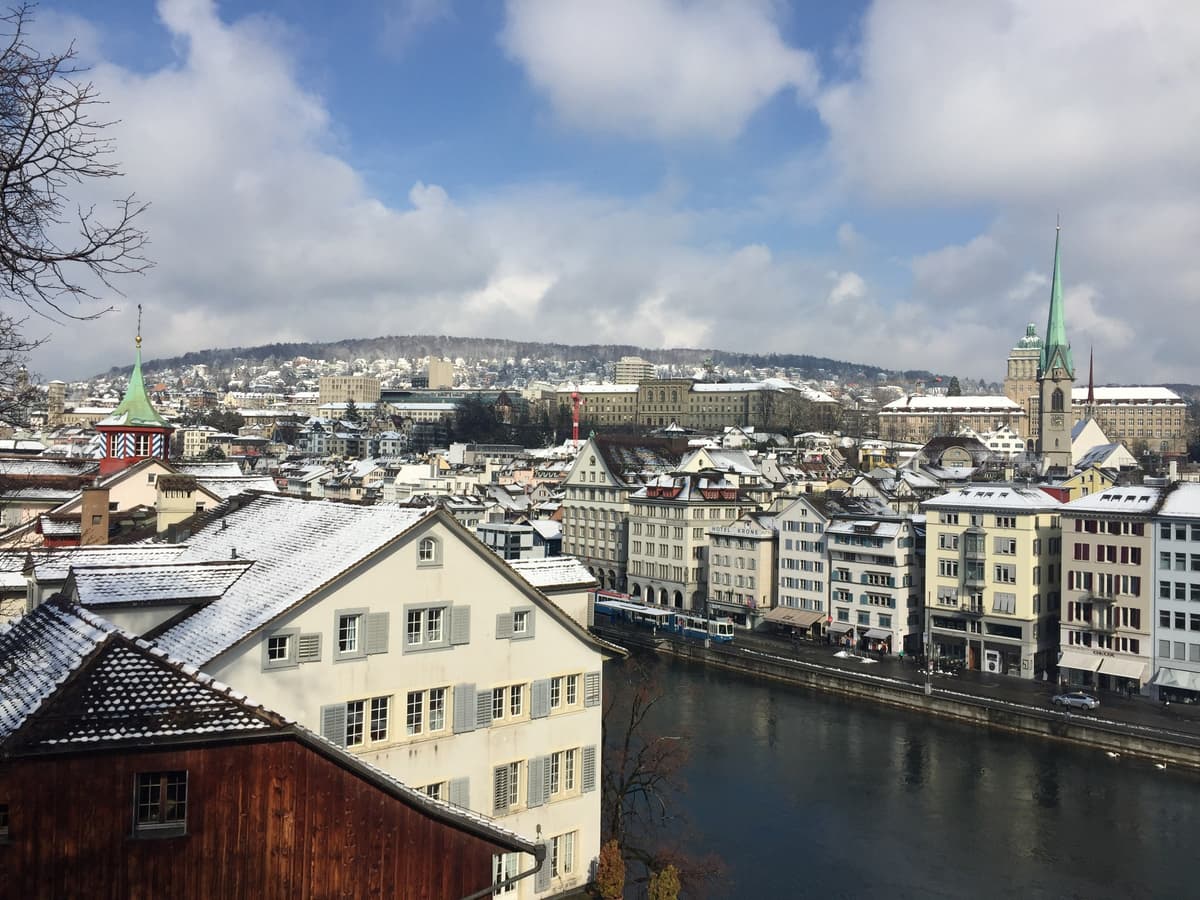
The terrace looks east across the Limmat to the right bank: the Old Town with the Grossmünster and the Rathaus, and the buildings of the University of Zurich and ETH Zurich. The viewpoint is at the square's east edge, over the river, 5 min on foot from the Rathausbrücke. Until autumn 2027, the Grossmünster's twin towers are wrapped in scaffolding.
Across the river, the Polyterrasse and the Karlsturm are two viewpoints on the right bank. The sunset times by month are computed for the Lindenhof viewpoint.
From a Celtic hill to a Roman fort and a royal palace
The Lindenhof is part of a moraine ridge that the Linth glacier left about 20,000 years ago. People have lived on it without a break since the 1st century BC.
On the east, south and west, the Roman fort's wall ran where today's retaining wall stands, and over long stretches the Roman walls still carry it. Most of the masonry you see is late medieval, with ashlar of the 17th century.
The name Turicum, Roman Zurich, survives on a Roman tombstone of the late 2nd century, found on the Lindenhof in 1747. The original is in the Landesmuseum, and a copy is set in the wall of Pfalzgasse, at the way up to the square.
80 BC
A Celtic oppidum, a fortified town, stands on the hills of the Lindenhof and St. Peter.
40 or 30 BC
Roman troops are stationed in the Celtic settlement.
Early 4th century
A late Roman fort is built on the hilltop, between 284 and 330: a wall over 2 m thick, two gate towers and six to eight other towers. It still stands after the Roman Empire declines in the 5th century.
9th century
A Carolingian palace (Pfalz) is built on the hill. It is probably rebuilt in the 11th century, and the second building is at least 75 m long and 13 m wide.
1045–1055
Henry III stays at the palace six times and has it made a residence with a two-storey hall and a chapel.
Early 13th century
The palace, probably made a castle with towers and ditches by the Zähringer, is destroyed by the townspeople. The hilltop is levelled into a square.
1422
The Lindenhof is first recorded as planted with 52 lime trees and open to the public, with stone tables, crossbow stands, chess and a skittle alley. It is a festival ground and a place for political assemblies.
1780
The city has the square made a baroque park, with paths in a cross and on the diagonals, by Hans Caspar Fries.
1798
The people of Zurich swear the oath to the Helvetic constitution on the Lindenhof.
1852–1854
The Freemasons' lodge is built, a neo-Gothic temple with stepped gables and a double flight of open steps up to the square.
1912
The fountain with Gustav Siber's figure is built.
1937/38
The first large excavations. Afterwards the city lays out a gravel square in place of the lawns.
1971
A lime tree is planted for the introduction of women's right to vote.
The fountain and the legend of the women of Zurich
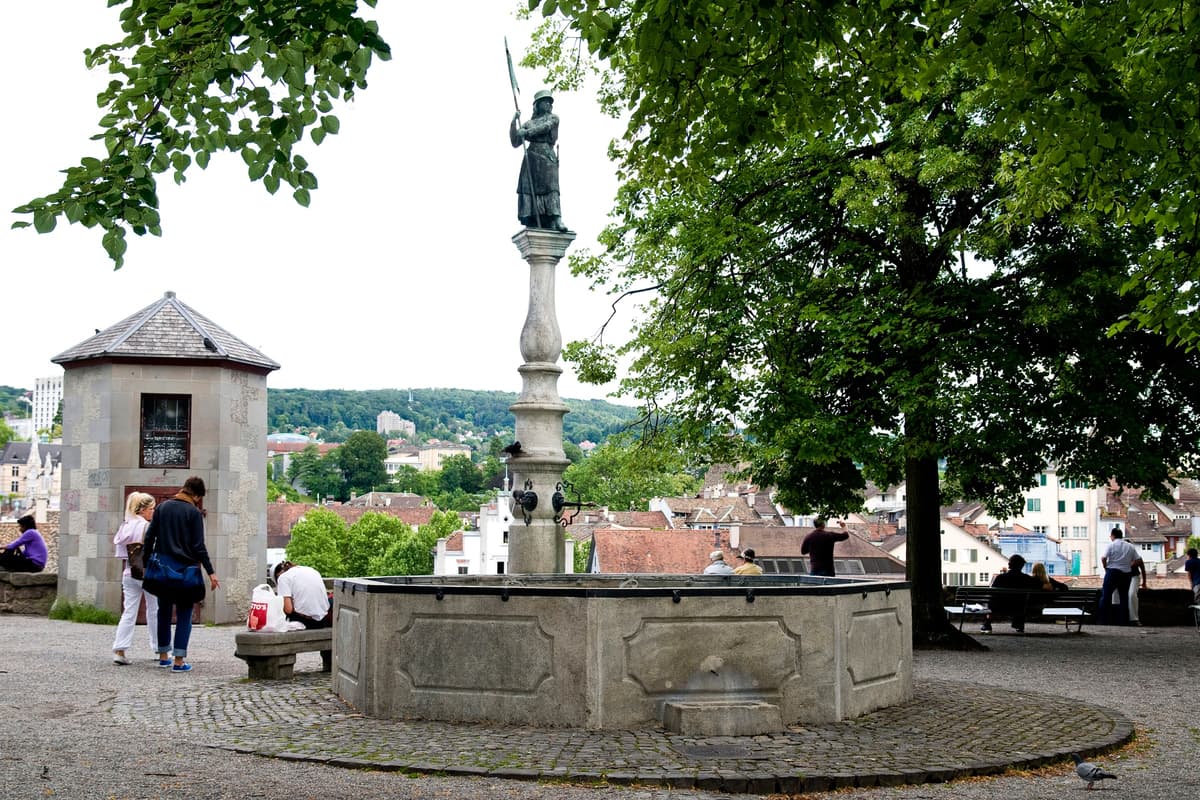
The Lindenhof fountain was built in 1912. Its figure, by the sculptor Gustav Siber (1864–1927), recalls a legend. In 1292, when the army of Duke Albrecht I of Habsburg stood before the town, the women of Zurich gathered on the Lindenhof in battle dress, and the army took them for a strong garrison and was deterred.
The first fountain on the square dates from 1668, with a small fountain house that lifted water up to the terrace. To the water utility the present one is the Lindenhofbrunnen, fountain no. 14, and its water is drinking water.
In the north-west of the square stands a sandstone block about 70 cm high. It was very probably the plinth of an 18th-century statue of William Tell, destroyed by unknown people on the night of December 1, 1800.
Chess, pétanque and the playground
55 lime trees and one chestnut shade the gravel square. Under them are tables where people play chess, and pétanque tournaments and theatre performances are held regularly. There is a playground for children and an accessible toilet. One of the limes was planted in 1971 for women's right to vote.
Sechseläuten opens on the Lindenhof on April 16, 2027.
The way up from each side
Pfalzgasse, without steps
Pfalzgasse climbs from Strehlgasse and In Gassen to the square, with no steps. From the Rathausbrücke the way crosses Weinplatz and follows Strehlgasse: 260 m, 4 min on foot on the flat, a little longer for the climb. The copy of the Roman tombstone is set in its wall, at the way up.
Lindenhofstrasse, from the north
Lindenhofstrasse comes up from the north side, with 6 steps at the top. It is the way from Zürich HB (Zurich main station): 620 m and 9 min on foot from the main hall's exit to Bahnhofstrasse.
Fortunagasse, from the river
From the Schipfe, the riverside lane below the hill, the Fortunagasse stair climbs 45 steps to the square.
The Freemasons' lodge steps
The Freemasons' lodge of 1852–1854 has a double flight of open steps up to the Lindenhof.
Trams 7, 11, and 13 to Rennweg
Rennweg is the nearest tram stop, on Bahnhofstrasse. From there, follow Rennweg to Pfalzgasse and climb it to the square.
- Lindenhof viewpointAt the east edge of the square, over the Limmat.
- Lindenhof fountainBuilt in 1912, with Gustav Siber's figure. Drinking water.
- Roman tombstone (copy)In the wall of Pfalzgasse, the way up without steps.
- Rennweg tram stopTrams 7, 11, and 13.
Frequently asked questions
What is the Lindenhof in Zurich?
A public square on a moraine hill on the left bank of the Limmat, more than 20 m above the river, with lime trees and a view over the Old Town. A Roman fort stood here from the early 4th century, then a Carolingian palace; the townspeople destroyed its castle in the early 13th century.
Can you still see the Roman fort on the Lindenhof?
Over long stretches, the fort's walls still carry the terrace's retaining walls, and on three sides today's wall follows the fort's line. A copy of the Roman tombstone that names Turicum is set in the wall of Pfalzgasse; the original is in the Landesmuseum.
Is there a way up to the Lindenhof without steps?
Yes. Pfalzgasse, from Strehlgasse and In Gassen, has no steps. Lindenhofstrasse has 6 steps and the Fortunagasse stair 45. The square has an accessible toilet.
How far is the Lindenhof from Zurich main station?
620 m, 9 min on foot from the exit to Bahnhofstrasse, up Lindenhofstrasse. By tram, trams 7, 11, and 13 stop at Rennweg, a short walk from Pfalzgasse.
What does the figure on the Lindenhof fountain stand for?
It recalls the women of Zurich who, in the legend of 1292, gathered on the Lindenhof in battle dress and deterred the army of Duke Albrecht I of Habsburg. The figure is by Gustav Siber, and the fountain dates from 1912.