Grossmünster

The Grossmünster is the Reformed church with the twin towers on the right bank of Zurich Old Town, where Huldrych Zwingli preached from 1519. Entry is free. It is closed on Tuesdays and opens the other days from 10:00, Sundays from 12:00, until 18:00 in summer and 17:00 in winter. Climbing the Karlsturm's 187 steps costs CHF 5.

Updated

Key facts

Entry
FreeClosed on Tuesdays
Opening hours
10:00 to 18:00March to October; until 17:00 from November to February; Sundays from 12:00
Karlsturm
CHF 5CHF 2 reduced; under 6 free
Steps
187To a platform at about 50 m; no lift
Crypt
FreeClosed on rainy days
Cloister
10:00 to 17:30Daily, March to October; until 16:30 in winter
Photos
AllowedNo flash or tripod, not during services
Scaffolding
Until autumn 2027Church and tower stay open

Opening hours of the church, the crypt and the cloister

Grossmünster opening hours
WhatMarch to OctoberNovember to February
Church, Monday and Wednesday to Saturday10:00 to 18:0010:00 to 17:00
Church, Sunday12:00 to 18:0012:00 to 17:00
Church, TuesdayClosedClosed
Cloister, every day10:00 to 17:3010:00 to 16:30
Scripture collection, Wednesday to Sunday12:00 to 17:0012:00 to 16:00

Last entry 5 minutes before closing.

The church is closed on Tuesdays, when students of the Zurich University of the Arts have organ lessons. On Sundays the service starts at 10:00, and visitors are let in from 12:00. On some days the church opens for shorter hours or stays closed.

Entry to the church and the crypt is free. The Karlsturm and the scripture collection share one paid ticket.

The ground floor of the church is wheelchair accessible. The gallery, the choir, the crypt and the Karlsturm are not.

Rules inside the church

  • No food or drink

    Eating and drinking are not allowed in the church.

  • No large luggage

    Large bags and suitcases cannot be taken into the church.

  • No animals

    Only guide dogs are allowed in.

  • No flash or tripod

    Photos for private use are allowed outside services, without flash or tripod. Sigmar Polke's windows are protected by copyright.

Climbing the Karlsturm: steps, hours and tickets

Of the two towers, visitors climb the Karlsturm, the south tower on the Limmat side. 187 steps lead up to a platform at about 50 m, with a view over the city and the lake as far as the Glarus Alps. The tower also holds a work of street art, Harald Naegeli's Totentanz (Dance of Death). Both towers got their present helmets after a fire in 1786; for their shape, they are sometimes called the "lemon squeezers" (Zitronenpressen).

There is no lift, and some passages are narrow. Large luggage, bags and umbrellas cannot be taken up. The last climb starts an hour before the church closes. The Karlsturm stays open while the church is under scaffolding.

Karlsturm opening hours
DayMarch to OctoberWinter, from November 20, 2026
MondayClosed12:30 to 16:00
TuesdayClosedClosed
Wednesday and ThursdayClosed12:30 to 16:00
Friday and Saturday10:00 to 17:0010:00 to 16:00
Sunday12:00 to 17:0012:00 to 16:00

The tower may close early, or for a while, for church events or in bad weather. On busy days the climb is not guaranteed.

Karlsturm tickets
TicketPrice
AdultsCHF 5
Ages 6 to 16, students with ID, KulturLegi holders, pensionersCHF 2
Children under 6Free
Groups of 5 or moreCHF 4 each
School classesCHF 1 per child and adult
Combined ticket with the FraumünsterCHF 8, reduced CHF 2

Tickets are sold only at the tower's desk, with no reservations. You can pay in cash, by credit card or with Twint. The ticket also lets you into the scripture collection and takes CHF 5 off entry to the collection of the Kunsthaus Zürich.

The combined ticket covers the Karlsturm and the Fraumünster with its Chagall windows and crypt museum: CHF 8 instead of CHF 10 for an adult.

What to see inside: the windows, the crypt and the doors

Augusto Giacometti's choir windows

The three tall windows of the choir tell the story of Christ's birth. Giacometti designed them in 1928, and the glass was made from 1932 to 1933. They show Mary with the Child, the bearers of gifts, angels, fruit and the star of Bethlehem, and at the bottom two kings bringing their gifts in golden vessels.

Sigmar Polke's windows

Polke's twelve windows came out of a competition held in 2005/06. The seven in the west are panes of agate and stand for the earth's history and prehistory. Further east, five windows show Old Testament figures read as forerunners of Christ: the Son of Man, Elijah's Ascension, King David, the Scapegoat and the Sacrifice of Isaac.

The crypt

The crypt and the choir were built first, from 1100 to 1117. Wall paintings of the 14th and 15th centuries show the martyrdom of Felix and Regula, the city's patron saints. The crypt also keeps the 15th-century original of the seated figure of Charlemagne from the south tower.

  • Free, during the church's hours
  • Closed on rainy days, to protect the paintings
  • Not wheelchair accessible

The Twelve Apostles' Chapel (Zwölfbotenkapelle)

The former chapel has frescoes, a model of the minster as it was first built, and parts of an early view of Zurich. It is open for quiet prayer.

Otto Münch's bronze doors

Both portals have bronze doors by Otto Münch. The south portal, from about 1130, has the door with scenes of the Reformation, made from 1935 to 1938. The main portal on the north side, from about 1180, has the door with scenes from the Bible, made in 1950.

The scripture collection

The exhibition "Getruckt zů Zürich" (printed in Zurich) shows the Grossmünster's Bibles and writings. It opens from Wednesday to Sunday, and the Karlsturm's ticket covers it.
Where it is and how to get there

The Grossmünster stands at Zwingliplatz 7, on the right bank of the Limmat, 5 min on foot from the Rathausbrücke. The main portal, on the north side, faces Zwingliplatz; the Karlsturm is the tower on the river side.

  • Trams 4 and 15 to Helmhaus

    Helmhaus is the stop by the church, on the Limmatquai.

  • From Stadelhofen station

    S-Bahn trains stop at Stadelhofen, 590 m and 8 min on foot from the church.

  • From Zürich HB

    From Zürich HB (Zurich main station), the church is 1.1 km away, 15 min on foot from the hall's exit to the Bahnhofquai.

  • From Central

    From the Central stop, Niederdorfstrasse leads through the Niederdorf to the church in 12 min on foot.

The Grossmünster, the Karlsturm and the nearest stops
  1. GrossmünsterThe church, the crypt and the cloister. Zwingliplatz 7.
  2. KarlsturmThe south tower, the one visitors climb.
  3. Helmhaus tram stopTrams 4 and 15.
  4. Stadelhofen stationS-Bahn; 8 min on foot to the church.

Zwingli, Bullinger and the Reformation

Until the Reformation, the Grossmünster was both the church of a foundation of canons and a parish church. In 1519 the city council chose Huldrych Zwingli as its people's priest. He preached his way through whole books of the Bible and spoke against mercenary service, the cult of the saints and the Mass, and he won over the people and the government.

Altars and images were then removed, the monasteries dissolved and the church given a new order.

On December 9, 1531, after Zwingli had fallen in battle, Heinrich Bullinger was called to succeed him. Born in Bremgarten in 1504, he died in Zurich in 1575.

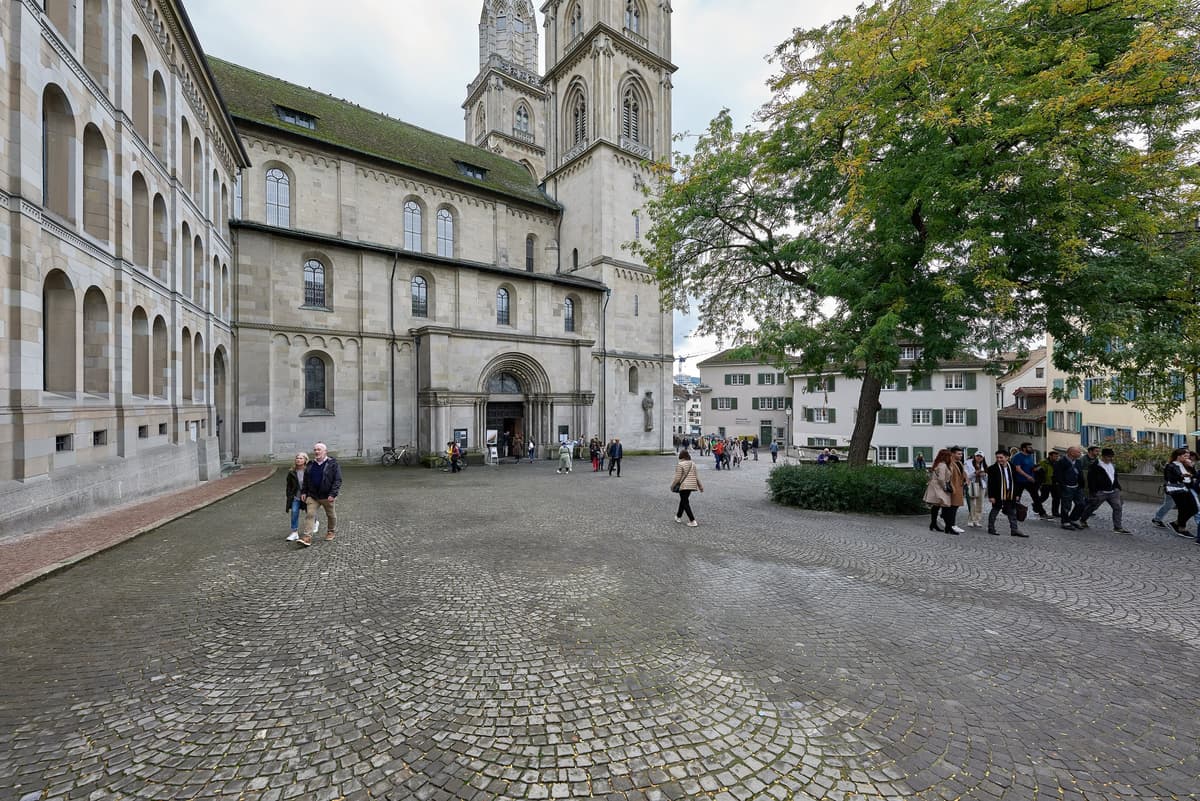
The side of a large Romanesque church with a round-arched portal, its two towers rising behind, a cobbled square with a tree and a few walkers in front
The Grossmünster's north portal and towers from Zwingliplatz, 2022, before the scaffolding

Felix and Regula, Charlemagne and the name

In the founding legend, Felix and Regula, the two saints of the city, carried their own heads after they were beheaded to the place where they wished to be buried. Charlemagne is said to have found their graves later and founded the church and its foundation of canons there. The legend is not historically certain.

Charlemagne sits in a niche on the south tower, as a seated figure that is today a copy. The 15th-century original from the tower is kept in the crypt.

The name Grossmünster first appears in the 14th century; before that, the sources call it simply the "Zürcher Kirche", the Zurich church. "Münster" comes from the Latin monasterium, and "gross" (great) probably set it apart from the smaller Fraumünster.

The cloister

The late Romanesque cloister dates from about 1200 and belonged to the canons' foundation. When the school was built in 1850, it was renewed using old parts, and it was restored from 1962 to 1963. The original sculptures are mostly in the west and south wings; in the others, casts, copies and new work take their place. Figures, animals and grotesque faces are carved on the pillars and arches.

The garden is inspired by Konrad Gessner. The cloister also holds the Zwingliverein's permanent exhibition "Kernpunkte der Reformation" (key points of the Reformation).

Services, music and guided tours

Besides the Sunday service, the Grossmünster has its organ and a Kantorat, a choir that singers can join. Concerts are also held in the crypt, and private organ concerts can be booked.

Volunteers give free short tours of 10 to 15 minutes, usually from Friday to Sunday. The parish has more than 50 public tours on more than 20 topics, and private tours in English too. Groups of up to 30 can visit without booking; from 11 people, a group brings its own tour-guide headsets.

The free Altstadtkirchen Zürich app has an audio tour of the Grossmünster in German, English, and Spanish. It needs headphones, which the church's shop sells, and the church has free Wi-Fi.

The restoration of the outer shell

The Canton of Zurich has been restoring the Grossmünster's outer shell since 2025, and the work runs until 2028: the stone facades on every side, the roof timbers and the roofs. The tower helmets and the roof turret are painted again in the colors of the last restoration, in 1990. The organ window gets new glass. The whole project, inside and out, runs from 2021 to 2031.

The scaffolding's cover is a collage of photographs by the Zurich artist Shirana Shahbazi, "Tut um Gotteswillen etwas Tapferes" (For God's sake, do something brave), opened on June 6, 2026. In good weather, the canton's tours of the building site include a climb on the scaffolding to watch the stonemasons at work.

Frequently asked questions

Is the Grossmünster a Catholic church or a cathedral?

Neither. The Grossmünster is a Reformed (Protestant) church, and the parish and the canton call it a church, not a cathedral. Until the Reformation it was the church of a foundation of canons and a parish church; Huldrych Zwingli preached there from 1519.

How much does it cost to climb the Grossmünster tower?

The Karlsturm costs CHF 5 for adults and CHF 2 for ages 6 to 16, students, KulturLegi holders and pensioners; children under 6 go free. Tickets are sold only at the tower's desk. A combined ticket with the Fraumünster costs CHF 8.

How many steps does the Grossmünster tower have?

The Karlsturm, the south tower, has 187 steps up to a platform at about 50 m. There is no lift, some passages are narrow, and bags and umbrellas cannot be taken up.

Is the Grossmünster open on Tuesdays?

No. The church is closed on Tuesdays, when students of the Zurich University of the Arts have organ lessons, and so is the Karlsturm. On the other days it opens at 10:00, on Sundays at 12:00, and closes at 18:00 from March to October and at 17:00 from November to February.

Is the Grossmünster open during the restoration?

Yes. The church and the Karlsturm stay open while the Grossmünster is scaffolded, in full in 2026 and 2027. Most of the scaffolding comes down in autumn 2027.