4 min on foot
The square on the hill stands on the late Roman fort, whose walls still carry the terrace's retaining walls over long stretches. A copy of the tombstone that names Turicum is set in the wall of Pfalzgasse, at the way up.
Zurich Old Town grew from a Celtic oppidum of 80 BC on the Lindenhof hill and the Roman customs post of Turicum. The Fraumünster abbey of 853, the guild revolution of 1336 and Zwingli's Reformation from 1519 shaped the walled town. The walls came down from 1780, and Bahnhofstrasse was laid out on the filled moat from 1864.
Updated
80 BC
A fortified Celtic town stands on the hill of the Lindenhof and St. Peter. Its wealthy elite runs a mint.
40 or 30 BC
Roman soldiers move into the Celtic settlement, and a small town grows on both banks of the Limmat.
About 200
A tombstone names the Statio Turicensis, a Roman customs post: the first record of the name.
Early 4th century
The Romans build a fort on the top of the Lindenhof.
853
King Louis the German endows an abbey for his daughter Hildegard: the Fraumünster. In the same century a Carolingian palace stands on the Lindenhof.
1218
The Zähringer dukes, lords of the town, die out. From then on Zurich answers directly to the emperor and the Empire.
13th century
The town builds its walls and two bridges over the Limmat, and power moves from the Lindenhof down to the river.
1336
Rudolf Brun leads the guild revolution, and the masters of 13 new guilds take seats on the council.
1519
Huldrych Zwingli begins to preach at the Grossmünster.
1642
Star-shaped ramparts begin to rise around the town.
1694–1698
Today's town hall is built on the right bank of the Limmat.
1780
The medieval town wall begins to be pulled down.
1798
The people of Zurich swear the oath to the Helvetic constitution on the Lindenhof, and guild rule ends.
1835
Building begins on the Limmatquai, and the town turns from the river towards the lake.
1864
The moat outside the left-bank wall is filled in, and Bahnhofstrasse is laid out in its place.
1916
The Dada movement is founded in Zurich.
1962
The city places the Old Town under protection.
From 80 BC a Celtic oppidum, a fortified town, stood on the moraine hill formed by the Lindenhof, St. Peter's hill and the Sihlbühl, a rise to the north that has since been dug away. A lump of more than 17,000 Celtic coins of about 100 BC, fused together, came to light in the southern part of Bahnhofstrasse; it may have been an offering placed in the water.
Roman soldiers were stationed in the settlement from 40 or 30 BC. Beside their post on the Lindenhof grew a small civilian town, the vicus Turicum, on both banks of the Limmat. About AD 70/75 a harbor quarter rose on new land at the foot of the Lindenhof, and the town spread to the right bank. A harbor and a river crossing are thought to have been at today's Rathausbrücke.
The name comes from a tombstone of about 200, which names the Statio Turicensis, a post of the Gallic customs that taxed goods at the border with Raetia. In the 2nd century a large public bath with underfloor heating stood below today's Weinplatz, beside the harbor's storehouses; its remains can be seen in the Thermengasse. In 680–700 the name was written "Ziurichi".
In the early 4th century the Romans fortified the top of the Lindenhof. The fort gave the people a home and a refuge after the troops had left and Roman rule had ended, and it became one of the cores of the medieval town.
The medieval town grew from several cores: the Lindenhof hill and the Fraumünster with the Münsterhof on the left bank, the Niederdorf and the Grossmünster on the right. The royal estate of Zurich was organized about 760, and in 853 King Louis the German endowed the Fraumünster abbey with it. His daughters Hildegard and Berta were its first abbesses. The oldest church of the abbey that archaeologists have found was a large 9th-century building with a transept and three apses.
On the Lindenhof stood a Carolingian palace of the 9th century. The abbess of the Fraumünster ranked as a princess of the Empire, recorded from 1234: she granted the rights to mint coins and to levy customs, and she set the coinage and the measures.
From 1173 to 1218 the Zähringer dukes were the sole lords of the town. When they died out in 1218, the king kept the imperial bailiwick of Zurich but no longer gave it to a prince as a hereditary office, only for a term to an imperial official. The town thus answered directly to the emperor and the Empire, a status confirmed several times up to 1512, and on it the town built its own government. A council is recorded from 1220, and a Rathaus from 1252.
In the 13th century new walls replaced an older one, and the political center moved from the Lindenhof down to the river. The Rathausbrücke and the Münsterbrücke were built in the first half of that century, and the town's growth brought the Oetenbach convent and the Rennweg on the left bank. The walled town covered 38 hectares: the Mehrere Stadt (the greater town) on the right bank, with the wards Auf Dorf, Linden, Neumarkt, and Niederdorf, and the Mindere Stadt (the lesser town) on the left, with the wards Münsterhof and Rennweg.
In 1336 the guild revolution named after Rudolf Brun stopped the rise of the patrician families. The masters of the 13 new guilds took half the seats on the council, and Brun was elected burgomaster for life, with dictatorial powers.
The councillors he drove out were banished to Rapperswil. They tried to win back power, among other times in the Zürcher Mordnacht, the night of murder, of 1350, and failed.
Brun's guild constitution lasted, in changing form, until 1798. The guilds still march every spring in the parade of Sechseläuten.
Huldrych Zwingli, born in Wildhaus in 1484, was called to Zurich as people's priest in 1518 and preached at the Grossmünster from 1519. In 1522 respected citizens broke the church's fasting rules in public, citing him, and a conflict with the Bishop of Constance followed.
For the First Zurich Disputation, in January 1523, Zwingli summed up his teaching in 67 articles. The council recognized it and bound the priests to preach from scripture. A second disputation that October, on images and the Mass, reshaped the church and the town: the Mass was abolished, the images removed and the monasteries dissolved, and a poor law followed in 1525, with a marriage court. On December 2, 1524 the last abbess of the Fraumünster, Katharina von Zimmern, handed the abbey with all its rights and property to the city.
The Zurich Bible was worked out under Zwingli's lead. Radical followers, among them Konrad Grebel, Felix Manz, and Jörg Blaurock, turned to the Anabaptists, and Zwingli and the council fought them hard. Zwingli was killed on the battlefield at Kappel am Albis on October 11, 1531, in the Second Kappel War. His successor, Heinrich Bullinger, kept his legacy with some changes. The statue of Zwingli by the Wasserkirche dates from 1885.
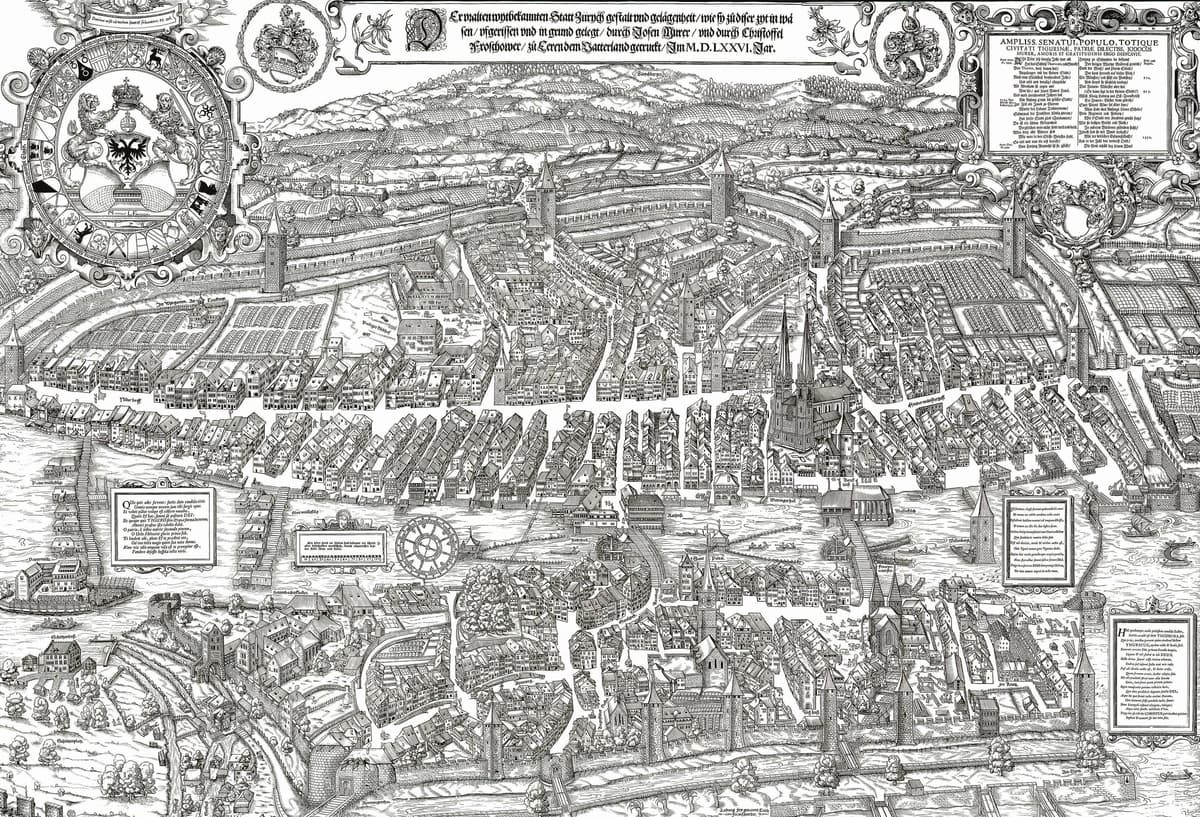
The first wall around the whole town dates from the building of the 12th century, and the walls of the 13th century replaced it. In 1521–1524 the town added the Rennweg bastion, the main gate on the left bank. Outside the left-bank wall ran the moat, the Fröschengraben and the Sihlgraben together 36 to 42 m wide.
From 1642 into the 18th century, star-shaped ramparts doubled the walled area. The Bauschänzli, built in 1660, and the Schanzengraben belonged to that baroque ring. The medieval wall began to be pulled down in 1780, and from 1833 the canton removed the ramparts, making room for public buildings and streets. In 1864 the moat was filled in, and Bahnhofstrasse runs where it was.
| Gate or tower | Came down | Notes |
|---|---|---|
| Oberdorftor | 1813 | Its tower was taken down for building material to fill in the lakeshore |
| Niederdorftor | 1824 | About where a crossing leads from the Central tram island to the Polybahn |
| Neumarkttor | 1827 | Its tower was 22 m high |
| Wellenberg | 1837 | A tower in the Limmat |
| Rennweg bastion | 1865 | Where Rennweg meets Bahnhofstrasse; about 21 m across and 22 m high |
| Kratzturm | 1877 | The walls' south-west corner, first recorded in 1397, on the Bahnhofstrasse sidewalk in front of the National Bank |
From 1835 the Limmatquai was built along the right bank, and by 1859 it was complete: Zurich turned from the river towards the lake. Today it is the riverside street of the Old Town.
The railway station opened in 1847, outside the Old Town, and set off the great building period of 1860–1890. Bahnhofstrasse was laid out from 1864, and from 1880–1890 came the stock exchange, the upper Bahnhofstrasse, the lake promenade and the Quaibrücke.
4 min on foot
The square on the hill stands on the late Roman fort, whose walls still carry the terrace's retaining walls over long stretches. A copy of the tombstone that names Turicum is set in the wall of Pfalzgasse, at the way up.
2 min on foot
In the lane off Weinplatz, a grid in the ground shows the remains of the 2nd-century baths.
4 min on foot
The church of the abbey founded in 853, which ended in 1524. Its crypt museum shows the walls of the early buildings.
3 min on foot
First recorded in 857, it was the town's only parish church in the Middle Ages. Rudolf Brun's grave is on the outer wall of its tower.
5 min on foot
Built between 1100 and 1230. Huldrych Zwingli preached here from 1519, and the bronze door of the south portal shows scenes of the Reformation.
3 min on foot
The carpenters' guild house on the Limmatquai, its core building dated to 1156.
7 min on foot
Remains of the 13th-century town wall and of the first water pipe, opposite the Predigerkirche.
2 min on foot
The town hall of 1694–1698, on the right bank of the Limmat.
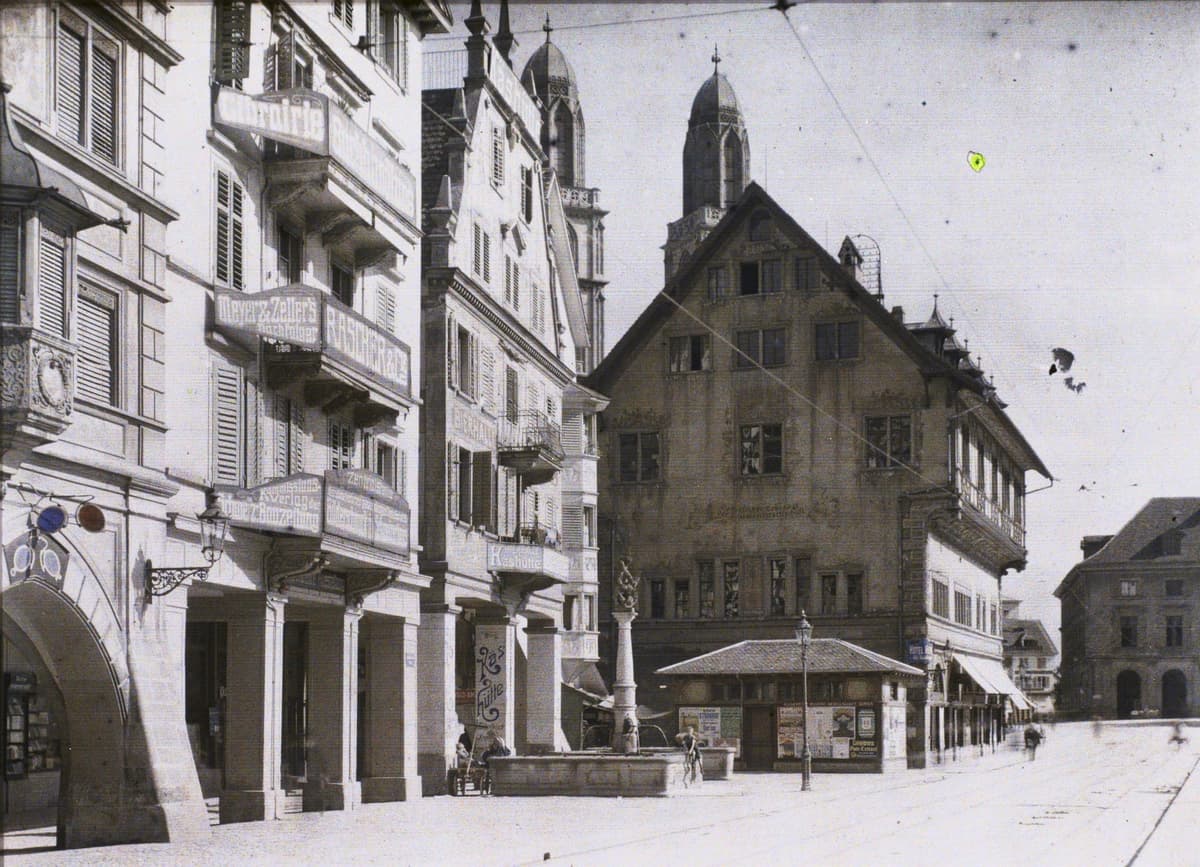
The Rennweg bastion, the left bank's main gate, stood at this corner until 1865. Bahnhofstrasse runs on the filled-in moat.
10 min on foot
The Niederdorftor stood about where a crossing leads from the tram island to the Polybahn's lower station, until 1824.
The town on the site goes back to a Celtic oppidum of 80 BC on the Lindenhof hill. Roman troops were there from 40 or 30 BC, and the name Turicum appears on a tombstone of about 200. The town's own council is recorded from 1220.
Turicum. A tombstone of about 200 names the Statio Turicensis, a post of the Gallic customs at the border with Raetia, and the small town around it was the vicus Turicum. The tombstone was found on the Lindenhof in 1747.
Huldrych Zwingli (1484–1531) led the Reformation in Zurich. Called as people's priest in 1518, he preached at the Grossmünster from 1519, and after the disputations of 1523 the council abolished the Mass and removed the images. He was killed in the Second Kappel War in 1531.
Only in remnants. The medieval wall was pulled down from 1780 and the ramparts from 1833. A rebuilt stretch can be seen in the Gräbligasse and an unaltered one in the Stadtmauerkeller at Chorgasse 22; the Bauschänzli and the Schanzengraben belonged to the baroque ramparts.
In 1336 the guild revolution named after Rudolf Brun stopped the rise of the patrician families. The crafts were grouped into 13 guilds whose masters took half the seats on the council, and Brun became burgomaster for life. The guild constitution lasted, in changing form, until 1798.
opens in a new tab