Storchenbrunnen
By Niederdorfstrasse 80, near Central.
The Niederdorf is the quarter of lanes on the right bank of Zurich Old Town. Its main street, Niederdorfstrasse, runs 460 m from Central to Rindermarkt and continues as Marktgasse and Münstergasse to the Grossmünster. The lanes are a pedestrian zone lined with shops, restaurants and bars, and in the evening the Niederdorf becomes an entertainment district.
Updated
Niederdorfstrasse, Marktgasse and Münstergasse make up the longest street of the medieval town, from the former Niederdorftor to the Grossmünster. The street winds slightly and widens into small squares, and its houses often hold shops, restaurants and bars.
Trams 3, 4, 6, 7, 10, and 15 stop at Central, 4 min on foot from the Bahnhofquai exit of Zürich HB (Zurich main station). Niederdorfstrasse starts on the south side of the square.
A long square with several corners, where the street widens; some of the buildings around it are Neo-Renaissance. In Advent the stalls of the Weihnachtsmarkt Dörfli stand here and along Niederdorfstrasse, one of the city's Christmas markets.
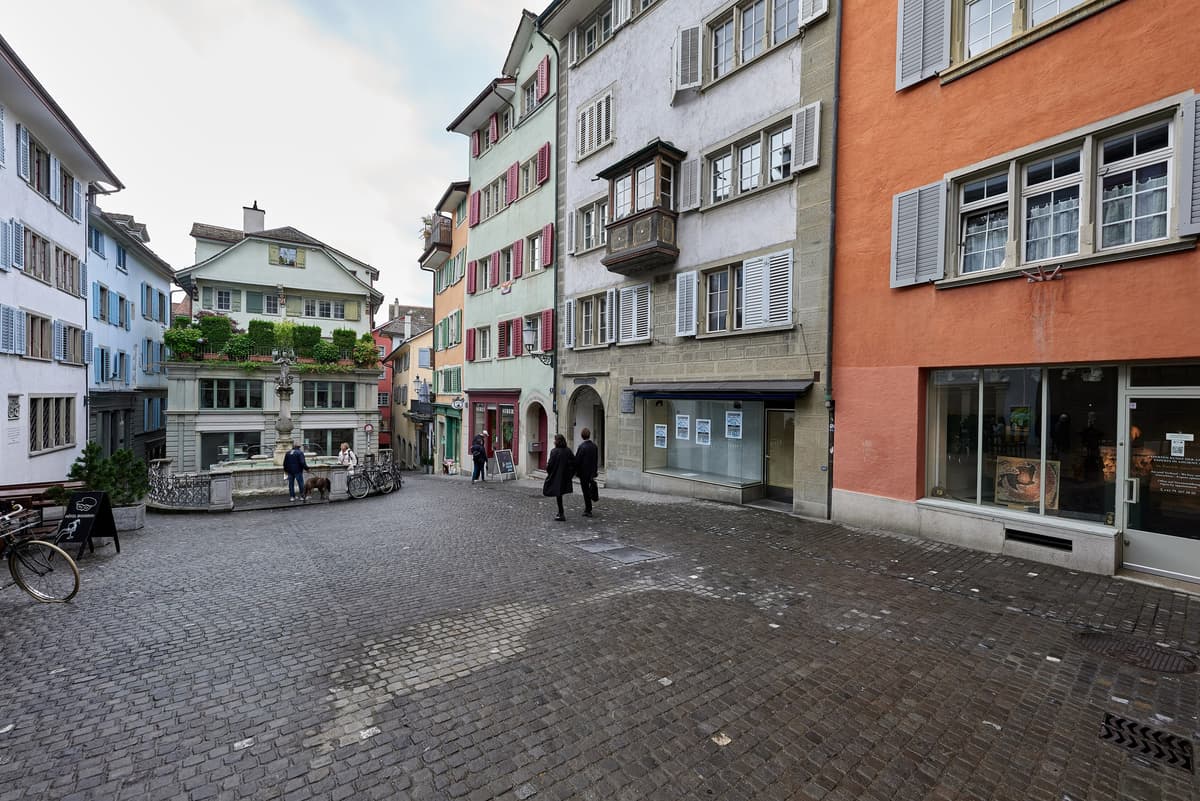
A square just west of the street, with a fountain and, on Rosengasse beside it, the Regenbogen Bar.
A square with the painted Stüssibrunnen. Just beyond it Niederdorfstrasse ends at Rindermarkt, and Marktgasse carries the route on.
Münstergasse leads on to the Grossmünster, passing the end of Spiegelgasse. From Central the whole way is 860 m, 12 min on foot.
Beyond the Grossmünster the route continues as Oberdorfstrasse, a narrow lane of small houses in the Oberdorf. Locals call the Niederdorf and the Oberdorf together the "Dörfli", an area that reaches as far as Bellevue.
Spiegelgasse runs 180 m from Münstergasse to the Neumarkt. At Spiegelgasse 1, Hugo Ball, Emmy Hennings, Hans Arp, Marcel Janco, Richard Huelsenbeck, and Tristan Tzara founded the Cabaret Voltaire, and with it the Dada movement. Its soirées ran from February 5, 1916 to the early summer of 1916. Today the house is free to visit, with a bar, a café and exhibitions.
Further along the lane, a plaque on the house at Spiegelgasse 14 recalls that Lenin lived there with his wife, Nadezhda Krupskaya, during the First World War. He moved to Zurich from Bern in 1916 and left in April 1917, after the February Revolution broke out in Russia. Whether he and the Dadaists knew each other is still unknown.
The German writer Georg Büchner wrote his plays "Leonce und Lena" and "Woyzeck" on Spiegelgasse around 1836.
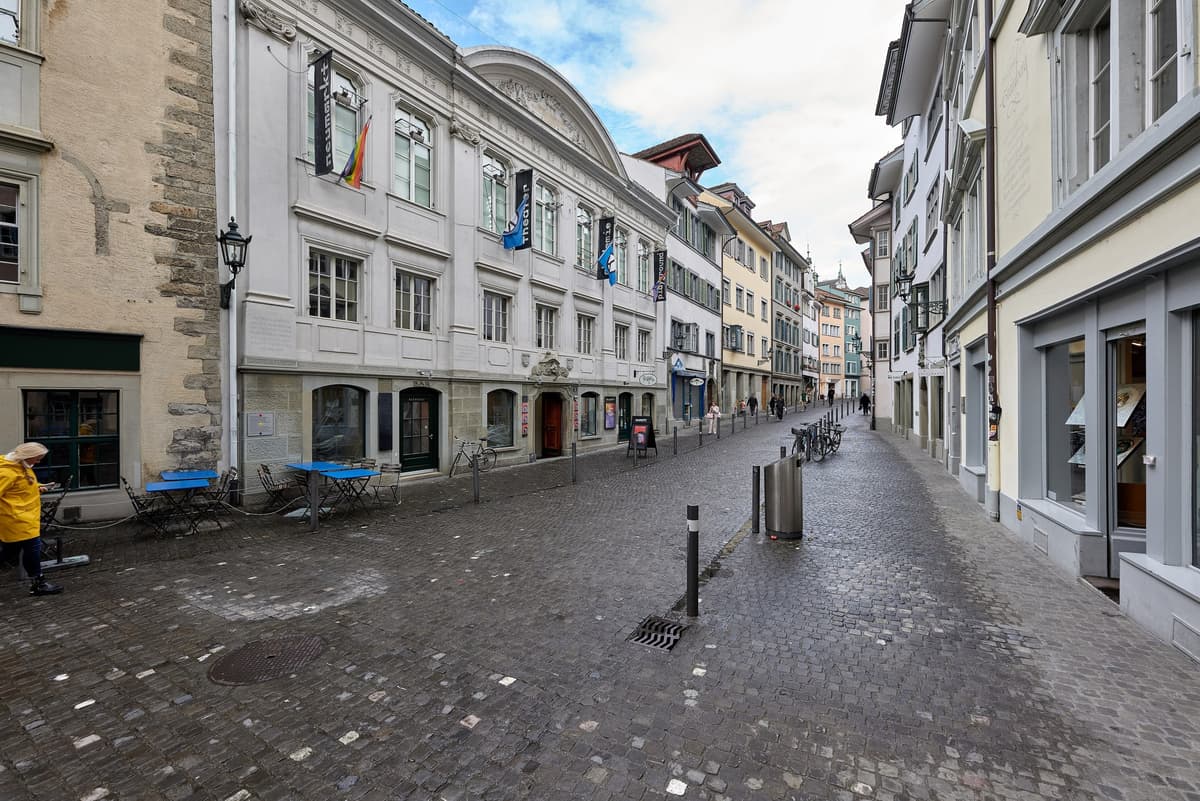
Spiegelgasse ends at the Neumarkt, a wide street of medieval houses, some of them grand, most with shops or restaurants. Its polygonal fountain with a column is the Nikebrunnen. The Grimmenturm on the Neumarkt dates from the 13th century.
Rindermarkt joins the Neumarkt to the end of Niederdorfstrasse. It is lined with narrow old-town houses and narrows just before it meets the Neumarkt. The writer Gottfried Keller grew up in a house on Rindermarkt. Slightly offset across the lane, at Rindermarkt 12, is the Oepfelchammer, a wine tavern. Since 1801 guests have carved their names into its benches and panelling, and they try the "Balkenprobe", climbing over two ceiling beams to drink a glass of wine upside down.
Zurich has more than 1200 fountains, and all of them run with drinking water, so a bottle can be filled at any fountain in the Niederdorf.
By Niederdorfstrasse 80, near Central.
The square west of Niederdorfstrasse has a fountain without a name of its own.
On Stüssihofstatt, probably from 1575. It is painted in several colors, and its figure is a knight. Whether he is Rudolf Stüssi, who died in the Old Zurich War in 1443, is uncertain. Gottfried Keller mentions the fountain in his novel "Der grüne Heinrich".
On the Limmatquai at Rüdenplatz (Limmatquai 48), on the river side of the Niederdorf. Its figure is the biblical Samson, and it is also called the Fischmarktbrunnen.
At the corner of the Neumarkt and Spiegelgasse. Its statue of Jupiter, made around 1750, was destroyed by a bomb one night in 1987. The sculptor Barbara Roth made a new figure, "l'étranger", and the god Jupiter became the goddess Nike.
At Napfgasse and Spiegelgasse. From 1576 it stood for more than 300 years in front of the medieval well tower on Napfplatz.
At the upper end of Kirchgasse. Its rearing horse of 1931 recalls the Manesse family of knights.
In the evening the Niederdorf, with its bars and pubs, becomes an entertainment district for a mixed crowd. By cantonal law bars and restaurants close from 24:00 to 05:00, but the city can allow later hours: Akt Niederdorf, Kon-Tiki, and Tina Bar stay open until 02:00 on Friday and Saturday nights.
Walking times are from the Rathausbrücke, the bridge by the Rathaus.
Restaurant and bar
8 min on foot 550 m
A restaurant-bar near Central with a terrace, classic cocktails and draught beer.
Cocktail bar
8 min on foot 550 m
Cocktails and snacks since 2012, with a large smoking room.
Tiki bar
5 min on foot 360 m
A tiki bar, opened in 1955.
Café and bar
5 min on foot 370 m
It shares its address with Kon-Tiki and takes no reservations.
Restaurant and bar
4 min on foot 260 m
A restaurant and bar by the Rosenhof that serves hot food.
Bar
4 min on foot 270 m
One floor up in the Brasserie Louis, with room for 40 and a smoking room for cigars.
Queer cocktail bar
2 min on foot 130 m
A queer cocktail bar since 1997.
Bar and café
3 min on foot 200 m
The bar and café of the Cabaret Voltaire, in the house where Dada began.
Tapas bar
3 min on foot 220 m
A tapas bar on the ground floor for walk-in guests; groups of 10 or more can book. The Spanish restaurant Sala Morisca is upstairs.
Folk music bar
3 min on foot 170 m
Live Swiss folk music in a former cow stable, where guests may play the instruments.
Two hotel bars and a cocktail bar stand in the lanes of the left bank. The Café Bar Odeon is on the right bank, at Bellevue.
Hotel bar
1 min on foot 60 m
The bar and lounge of the Storchen hotel, on Weinplatz.
Cocktail bar
3 min on foot 160 m
A cocktail bar near the Fraumünster; it takes no reservations.
Hotel bar
4 min on foot 240 m
In the Widder Hotel on Rennweg, with live piano; it takes no reservations.
Café and bar
8 min on foot 560 m
A café bar at Bellevue since 1911.
In the lanes of the Old Town, long-established businesses stand beside young ones: many fashion boutiques, watch and souvenir shops, and shops for Swiss history and design. On Niederdorfstrasse and the Neumarkt they stand among the restaurants and bars.
Shops in the canton may open from Monday to Saturday with no legal limit on their hours. On Sundays and public holidays they stay closed, except on the city's four Sunday sales a year. Across the river, Bahnhofstrasse has a department store and the watch and jewelry houses.
Niederdorfstrasse is 460 m long, from Central to Rindermarkt: 7 min on foot. As Marktgasse and Münstergasse it continues to the Grossmünster, 860 m and 12 min on foot from the Central stop.
"Dörfli", the little village, is the locals' name for the Niederdorf. They often mean the Niederdorf and the Oberdorf together, an area of the Old Town that reaches as far as Bellevue.
Cantonal law closes bars and restaurants from 24:00 to 05:00, and the city can allow exceptions. In the Niederdorf, Akt Niederdorf, Kon-Tiki, and Tina Bar stay open until 02:00 on Fridays and Saturdays.
At Spiegelgasse 14 in the Niederdorf, with his wife Nadezhda Krupskaya, for about a year during the First World War. A plaque on the house recalls it. He came to Zurich from Bern in 1916 and left in April 1917. The Cabaret Voltaire, where Dada began in 1916, is at Spiegelgasse 1 in the same lane.
The Niederdorf is a pedestrian zone, from Central to Bellevue. Delivery vehicles may drive in only from 05:00 to 12:00, and bicycles and e-scooters are pushed, except on the signed bike routes.
opens in a new tab