Fraumünster

The Fraumünster is the Reformed church on the Münsterhof in Zurich Old Town, with Marc Chagall's five choir windows of 1970. Entry costs CHF 5 and includes the crypt museum and an audio guide; young people up to 16 and students go free. It opens daily from 10:00, Sundays from 12:00, until 18:00 (17:00 in winter).

Updated

Key facts

Entry
CHF 5Free up to 16 and for students
Opening hours
10:00 to 18:00March to October; closes at 17:00 in winter, opens at 12:00 on Sundays
Chagall windows
Five in the choirFrom 1970; the rose window from 1978
Audio guide
IncludedApp in German, English, and Spanish, or a leaflet in nine languages
Crypt museum
IncludedOpen during the church’s hours
Photos
AllowedWithout flash or tripod, outside services
Address
Münsterhof 23 min on foot from Paradeplatz

Opening hours and tickets

Fraumünster opening hours
DayMarch to OctoberNovember to February
Monday to Saturday10:00 to 18:0010:00 to 17:00
Sunday12:00 to 18:0012:00 to 17:00

Last entry 15 minutes before closing. The hours may change at short notice.

On Sundays, after the service at 10:00, the church opens to visitors at 12:00. Anyone who comes to pray or reflect enters free.

There are no advance tickets online: you buy them at the church, in cash, by card or with Twint. The fee includes the crypt museum and an audio guide: the free Altstadtkirchen Zürich app in German, English, and Spanish (bring your own headphones), or an illustrated leaflet in nine languages. The ticket also takes CHF 5 off entry to the collection of the Kunsthaus Zürich, which has a group of works by Marc Chagall.

Fraumünster tickets
TicketPrice
AdultsCHF 5
Groups of 5 or moreCHF 4 each
Young people up to 16, students with ID, KulturLegi holdersFree
Combined ticket with the KarlsturmCHF 8, reduced CHF 2

For CHF 8 instead of CHF 10, an adult's combined ticket adds the climb up the Karlsturm of the Grossmünster, across the river.

Photos, rules and step-free access

  • Photos without flash

    Private photos are fine outside services, as long as no flash or tripod is used. Marc Chagall's windows are under copyright.

  • No eating or drinking

    Food and drink stay outside the church.

  • Luggage stays outside

    Large bags and suitcases are not allowed in.

  • Assistance dogs only

    Other animals are not allowed in the church.

The entrance, the nave, the shop and the exit are step-free. A few steps with a handrail lead up to the choir with the Chagall windows. The crypt museum is not wheelchair accessible. An accessible toilet is just inside the main entrance, on the right.

The Chagall windows: what each of the five shows

Marc Chagall's five tall windows in the choir were finished in 1970, and his rose window in the south transept followed in 1978. He made them with the glass painter Charles Marq in Reims. The Christ window in the middle of the east wall is given to the New Testament's message of Christ, with the Jacob window to its left and the Zion window to its right. The two windows on the side walls, the Prophets window on the north and the Law window facing it, take their themes mostly from the Old Testament. From left to right:

Red, on the left side of the choir

The Prophets window (Prophetenfenster)

Elijah is carried up to heaven in a chariot of fire, away from Elisha. A cherub hovers in the middle, and above it Jeremiah sits lost in thought in a blue robe. The Creation fills the arch.
Blue, at the front of the choir, on the left

The Jacob window (Jakobsfenster)

Jacob floats with his hands folded in his lap and his eyes open, dreaming of the ladder to heaven, which fills the upper part. Below it, Jacob wrestles with the angel.

Green, at the front of the choir, in the middle

The Christ window (Christusfenster)

The life of Christ from his birth to the Resurrection: Joseph, the Tree of Jesse, the Lamb of God, Mary, Elizabeth, the life and parables of Jesus, and the Crucified.

Yellow, at the front of the choir, on the right

The Zion window (Zionsfenster)

An angel announces the dawn of eternity, and below it the new Jerusalem comes down from heaven. King David, singer of the Psalms, and Bathsheba are shown underneath.

Blue, on the right side of the choir

The Law window (Gesetzesfenster)

Moses looks down on the disobedience and suffering of the people. Absolute peace is shown in the middle, and below it an angel holds Isaiah.

Giacometti’s window, the west window and the founding fresco

In the north transept

Augusto Giacometti's "Himmlisches Paradies"

The window, Heavenly Paradise, dates from 1945 and was Giacometti's last large work in glass. About 9 m high, it shows God the Father and Christ with prophets and evangelists, surrounded by angels.

Behind the organ

Clement Heaton's west window

The English glass painter made the large west window in 1914, at the end of the church's great renovation. It is mostly color and light, with four angels.

The founding fresco

About 1300, a large wall painting over the tomb of the first abbesses, Hildegard and Berta, showed the legend of the abbey's founding and the transfer of the relics of Felix and Regula. It was found under whitewash in 1847 and copied in watercolor; the original was later largely lost. After the interior renovation of 2006, an enlarged copy of the watercolor was hung above its original place.

The abbey, from 853 to 1524

On July 21, 853, King Louis the German founded an abbey for noble women in Zurich and gave it to his daughter Hildegard. A first church was consecrated on today's site in 874.

The south tower probably dates from the first half of the 12th century, the north tower from about 1220 to 1230. From about 1250 the church was largely rebuilt: the choir and the transept first in Romanesque forms, then in Gothic ones, and the nave in the 14th and 15th centuries. The nave and the towers were remodeled in the 18th century, and Gustav Gull's restoration in the 20th century gave the church its present look.

On December 2, 1524, during the Reformation, the last abbess, Katharina von Zimmern, handed the abbey and its church to the city. The abbey ended there, and the Fraumünster became a Reformed city church.

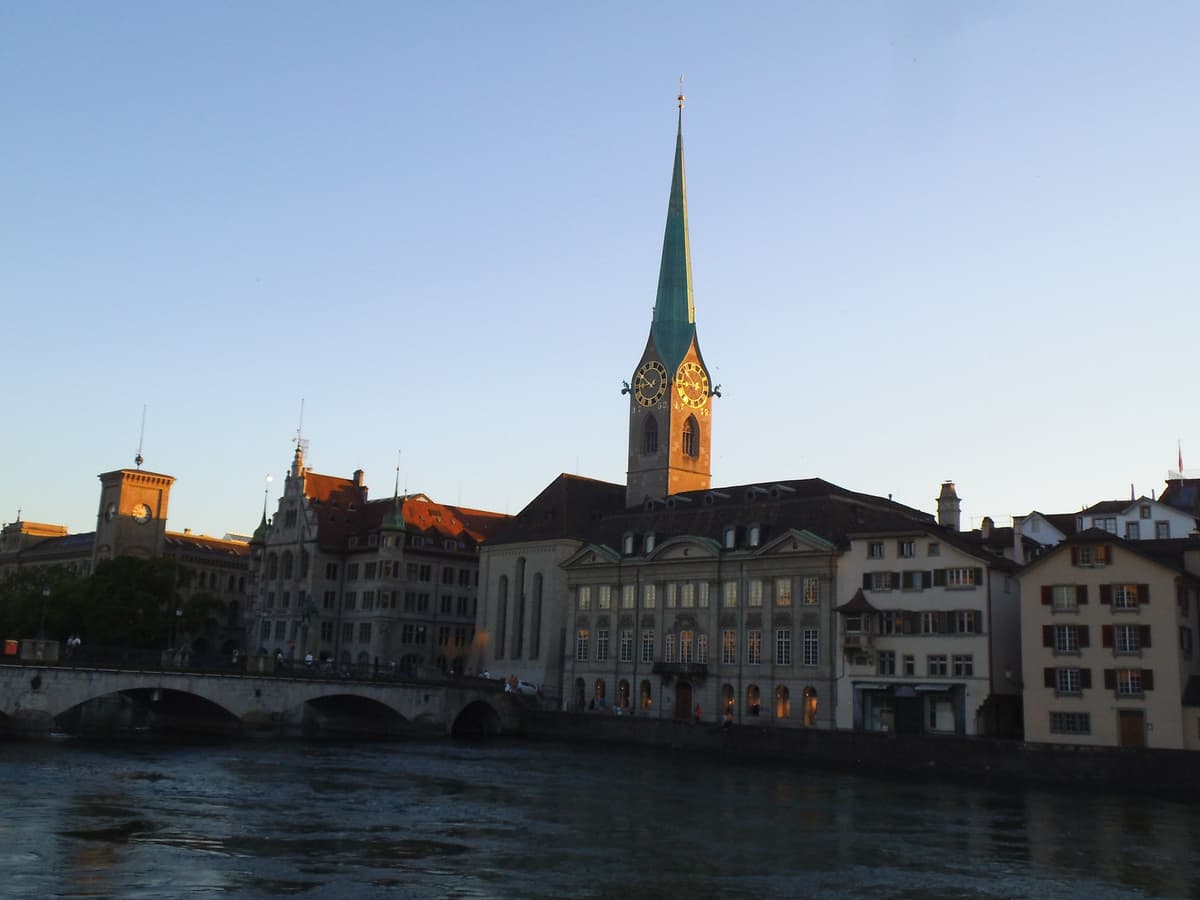
A slender green spire with gold clock faces lit by the low sun above a church and a baroque house on the riverbank, a stone bridge on the left
The Fraumünster's spire above the Limmat in the evening sun, with the Münsterbrücke and the Zunfthaus zur Meisen

The crypt museum

The remains of the abbey's crypt were found in 1900, during restoration work. The room was long used as a store, and after its renovation it has been open to visitors since 2016.

It shows walls of the early buildings, with drawings and animations that explain them, objects and facsimiles from Zurich's Reformation, and finds from recent digs, among them the head of a statue of Mary from the time of the iconoclasm. A multimedia exhibition covers 1200 years of the city's and the church's history.

Hours
As the church
Entry
Included
In the CHF 5 fee
Wheelchairs
No access

The cloister and Paul Bodmer's frescoes

What remains of the Romanesque and late Gothic cloister stands in the passage between the Stadthaus and the church. Its reliefs of Felix and Regula, from about 1170 to 1180, are copies. Gustav Gull freely completed the late Gothic parts in 1911, and the fountain by Hermann Würth dates from 1912.

Paul Bodmer (1886–1983) painted the frescoes on its walls in stages from 1924 to 1941, after the city government held a competition in 1921. They tell the legends around the abbey and the city: the founding of the abbey with the legend of the stag; Felix, Regula and Exuperantius; Charlemagne and the snake; Charlemagne founding the canons' school; and the transfer of the relics of Felix and Regula to the Fraumünster.

The first stage, in the entrance hall, shows the lives of Hildegard and Berta and was finished in 1928. The eight panels in the Gothic cloister tell the story of Felix and Regula. Bodmer began the third and last stage, the walls of the Romanesque cloister with the legends of Charlemagne, in 1937. The cloister is step-free.

The Münsterhof and how to get there

The Fraumünster stands at Münsterhof 2, on the left bank of the Limmat, 4 min on foot from the Rathausbrücke. Its long side faces the Münsterhof, the Old Town's largest square, which was laid out on the abbey's former cemetery. Two guild houses stand on the square, the Zunfthaus zur Waag and the Zunfthaus zur Meisen.

From the square, the lanes of the left bank lead on to Augustinergasse and St. Peter.

  • Trams 2, 5, 7, 9, 11, and 13 to Paradeplatz

    From the square at Paradeplatz, the church is 210 m away, 3 min on foot.

  • Trams 4 and 15 to Helmhaus

    Helmhaus is the stop by the Wasserkirche, on the right bank across the river.

  • From Zürich HB

    The walk from Zürich HB (Zurich main station) is 1.0 km, 14 min on foot from the hall's exit to the Bahnhofquai.

  • From the boats at Bürkliplatz

    From the lake boats' pier at Bürkliplatz, the church is 8 min on foot away.

The Fraumünster, the Münsterhof and the nearest tram stops
  1. FraumünsterThe church, the crypt museum and the Chagall windows. Münsterhof 2.
  2. MünsterhofThe square in front of the church.
  3. Paradeplatz tram stopTrams 2, 5, 7, 9, 11, and 13.
  4. Helmhaus tram stopTrams 4 and 15; across the river.

Frequently asked questions

How much does it cost to visit the Fraumünster?

The fee for a tourist visit is CHF 5, or CHF 4 each from 5 people, and it includes the crypt museum and an audio guide. Young people up to 16, students with ID and KulturLegi holders go free, and so does anyone who comes to pray. Tickets are sold only at the church.

What do the Chagall windows in the Fraumünster show?

Marc Chagall's five choir windows of 1970 are, from left to right, the Prophets window (Elijah's chariot of fire), the Jacob window (the ladder to heaven), the Christ window (the life of Christ), the Zion window (the new Jerusalem and King David) and the Law window (Moses). His rose window in the south transept is from 1978.

Can you take photos of the Chagall windows?

Yes, for private use and outside services, without flash or tripod. The windows are protected by copyright.

Is the Fraumünster open on Sundays?

Yes, from 12:00, after the 10:00 service, until 18:00 from March to October and 17:00 from November to February. Last entry is 15 minutes before closing. Until January 3, 2027, the church is closed on some Sundays.